
Most law firms should run Google Ads on their own name. A referred client who searches your firm should see your message first and recent research shows competitors take far more of a brand’s clicks when its own ad isn’t there. Google’s AI answers are also changing what people see before they reach your website. This article covers the three-search test, seven ways firms use branded ads, how branded ads show up in Google’s AI answers and how to set up a campaign.
Yes, for most law firms. Ads on your own firm’s name are the cheapest clicks you’ll buy and they’re the only way to control what sits at the top of the page when a referred client, a referrer or a lateral hire searches for you. Skip them only if no one else ever shows up for your name and you can live with whatever Google chooses to show.
What is a branded search?
A branded search is any search that includes your firm’s name or one of your lawyers’ names. The person searching has already decided to look you up. They want your phone number, your office, a lawyer’s profile or reassurance before they call.
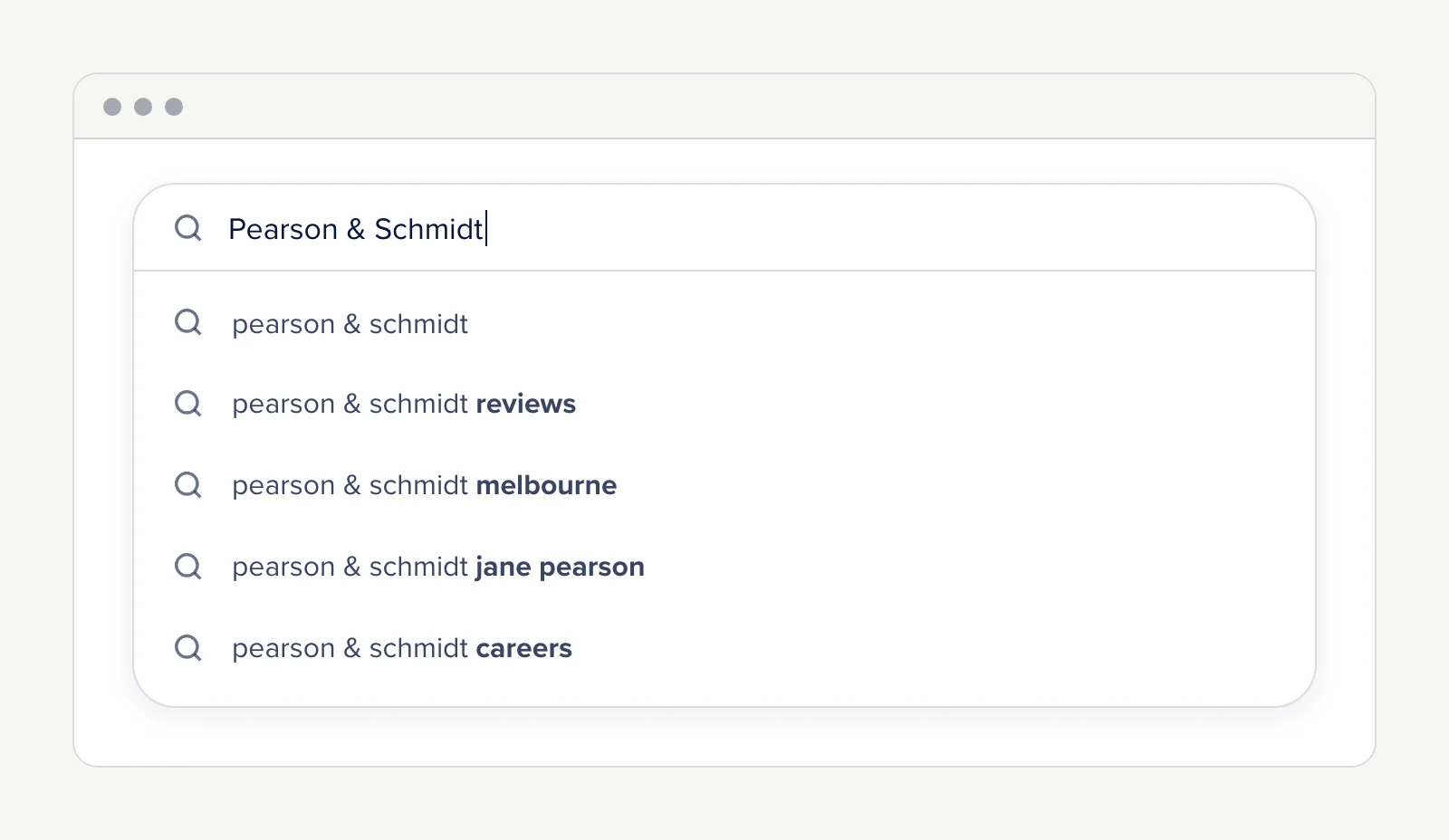
Branded searches usually come in four kinds:
| Search | What the person wants | Example |
|---|---|---|
| Name only | Your website or phone number | pearson & schmidt |
| Name + place | The right office | pearson & schmidt melbourne |
| Name + person | A specific lawyer | pearson & schmidt jane pearson |
| Name + question | Reassurance before they call | pearson & schmidt reviews, is pearson & schmidt any good |
The last kind is the one that’s changed most. More on that below.
What you control on the results page
Ranking first and controlling the page are different things. You can rank first organically and still have a competitor’s ad above you, odd sitelinks underneath you and an AI Overview quoting a three-year-old review.
This table shows what you control in each part of the results page:
| Part of the page | Who decides what shows | How fast you can change it |
|---|---|---|
| Your ad | You | Minutes, once approved |
| Ad sitelinks, callouts and call button | You | Minutes, once approved |
| Your organic result and its sitelinks | Google, influenced by your site | Weeks, if at all |
| Your Google Business Profile | You and Google, plus your reviewers | Days |
| The AI Overview | Google, drawing on everything it can find about you | Slowly, through your content and reputation |
What the research says about branded ads
Two recent studies explain why branded search matters more now than when I first wrote this article.
- Competitors take traffic when you’re not in the top ad spot. A large study of brand searches on Bing found competitors took 1% to 2% of a brand’s clicks when the brand held the top paid position. When the brand’s ad wasn’t there, competitors took 6% to 15% (Simonov and Hill, Marketing Science, 2021).
- AI summaries halve clicks. Pew Research tracked the browsing of 900 US adults. When Google showed an AI summary, people clicked a traditional result in 8% of visits, against 15% when there was no summary. They clicked a link inside the summary in just 1% of visits (Pew Research Center, 2025).
So fewer people click at all. The clicks that remain go to whoever holds the top of the page. Competitors pick up the gaps. Your firm’s name is the one search where you can always hold that spot. That’s why I recommend branded ads for almost every firm we work with.
How to judge a branded campaign: the three-search test
This is the test I run before recommending branded ads to any firm. It takes five minutes. On your phone, in a private browser window, search your firm the way a referred client would:
- Your firm’s name on its own. Is your firm’s site the first thing on the screen? Is there a competitor’s or directory’s ad above you? Do the sitelinks under your result point to pages you’d want a new client to see?
- Your firm’s name + “reviews”. What’s the first review a stranger reads? Is your Google Business Profile complete, with recent reviews and responses?
- “Is [your firm] any good?” Try it in Google’s AI Mode too. What does the AI say about you and which sources does it quote?
If all three searches show your firm the way you’d describe it yourself, a branded campaign is cheap insurance. If any of them shows a competitor, an outdated page or a source you don’t recognise, a branded campaign is the fastest fix for the first two searches. The third depends on your website and reputation as much as your ads.
I judge branded campaigns as insurance and intelligence. They protect the clients you’ve already earned through referrals and reputation and they show you exactly what people search alongside your name. Measure them by what they protect and what they reveal. Don’t expect them to find you new clients on their own.
Seven ways law firms use branded ads
Control the links people see under your name
Google picks the sitelinks under your organic result. Good site structure can influence them, but you can’t choose them. That’s how a junior lawyer’s profile or an old practice group page ends up being one of the first things a referrer sees.
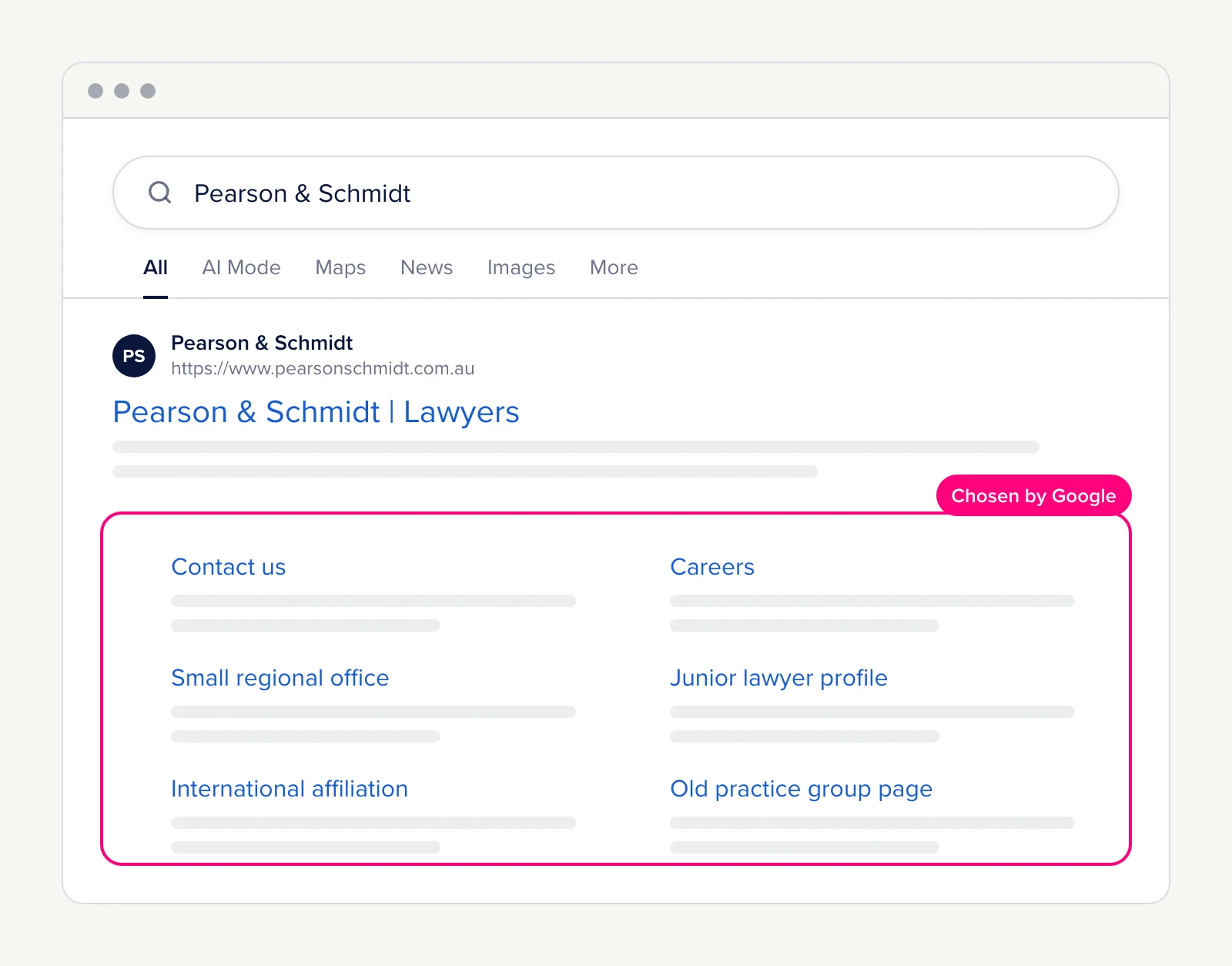
In an ad, you write every sitelink and choose where it goes. Once the ad is approved, the change shows straight away.
Announce a merger or new team
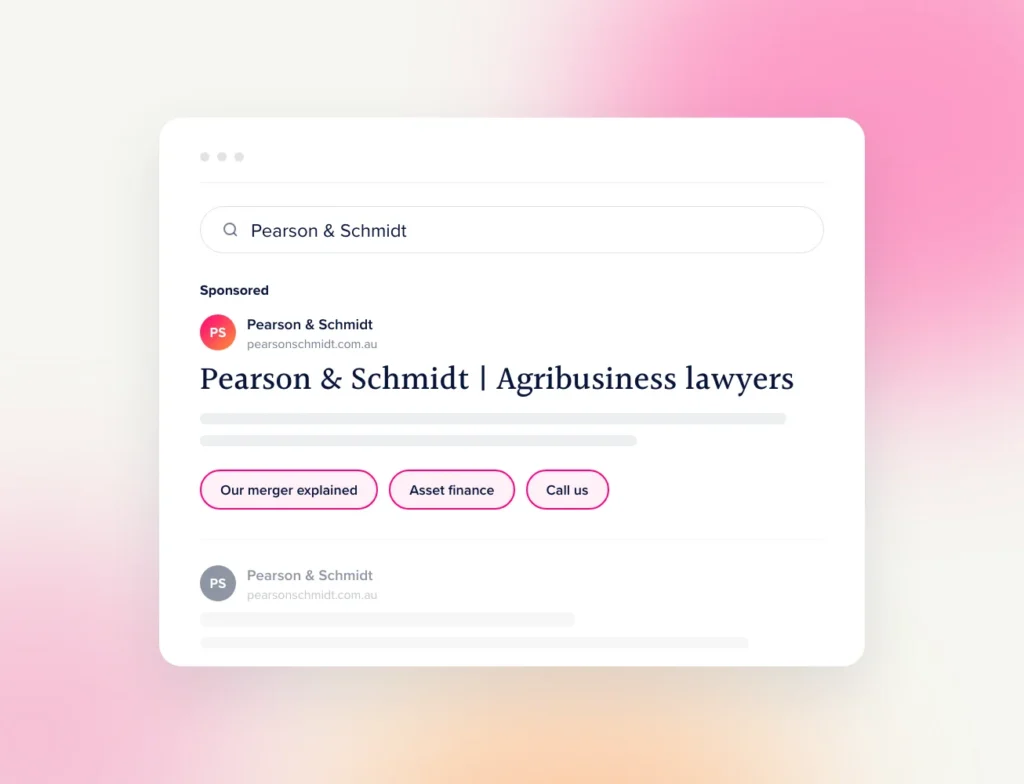
People who search your firm by name are mostly existing clients, prospective clients and referrers. They’re exactly who you want to tell about a merger. Here’s Pearson & Schmidt, a fictional agribusiness firm, using its branded ad to do it:
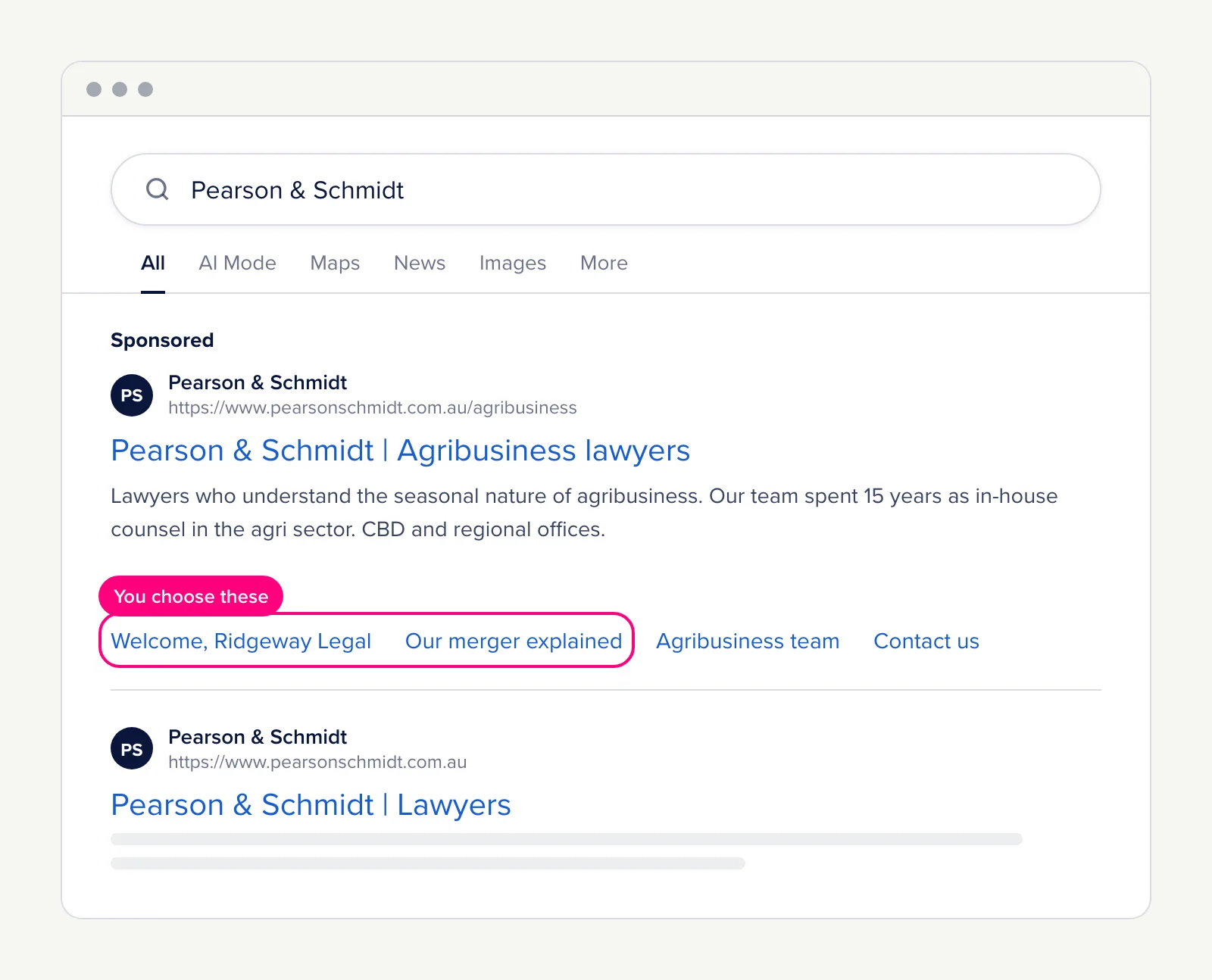
Link the sitelink to a page that explains who’s joining, what changes for clients and who to contact.
Promote a campaign for a few weeks
Sitelinks suit anything you want in front of people for a short time:
- a significant change in legislation
- a new lawyer or team with expertise that’s new to the firm
- a shift in economic conditions, such as a downturn or a boom in one industry
- media coverage the firm is getting on an issue
- a recruitment drive.
Pearson & Schmidt is also promoting its asset finance work alongside a case study about helping a client raise funds:
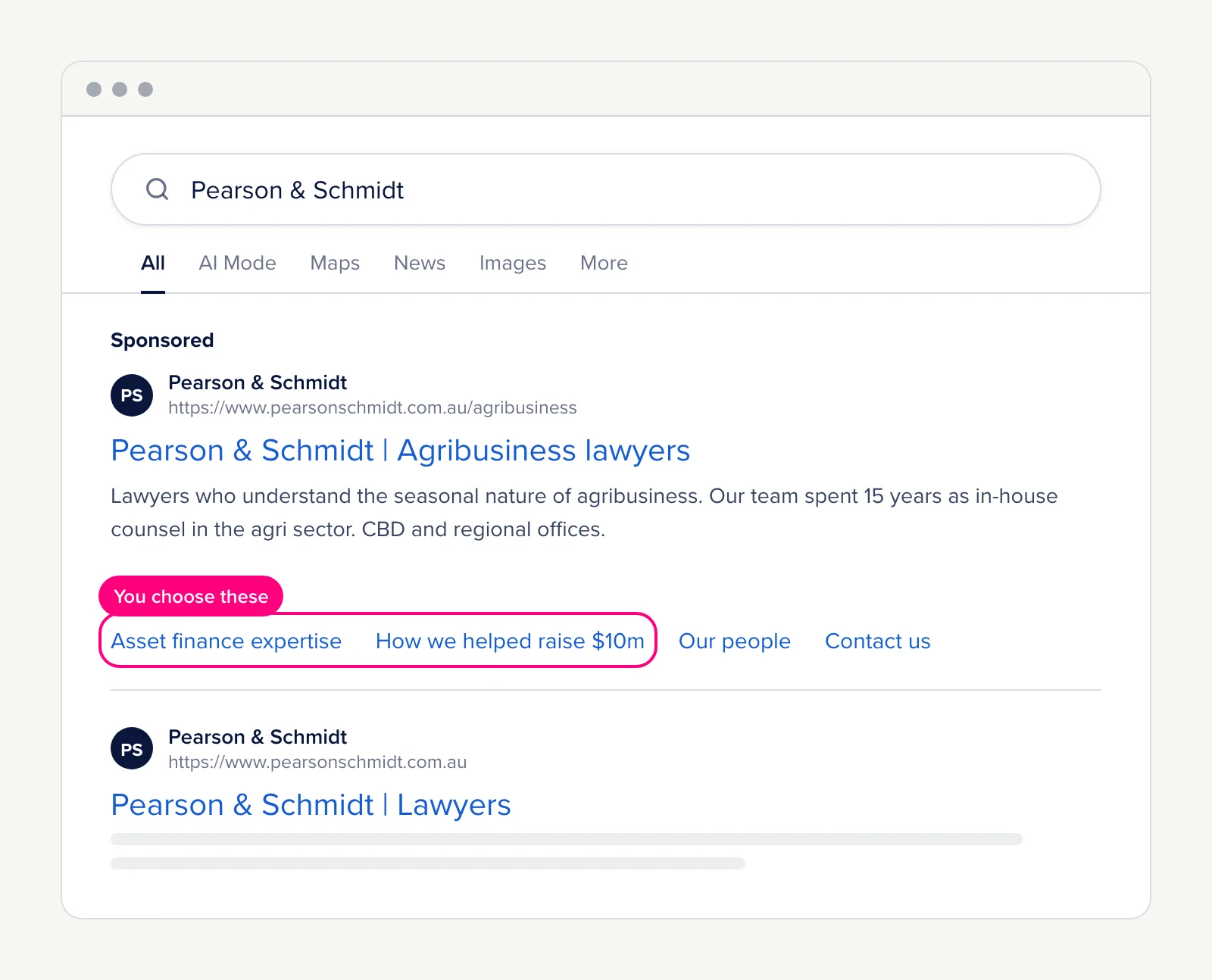
Having precise control of your messaging and potential offer is integral to running a strong branded PPC campaign. The benefits can be well worth the low cost per click associated.
David Pagotto, SIXGUN
For full-service firms, this is also a simple way to cross-sell practice groups clients don’t know about. “I had no idea you did that” is one of the most common things clients say about their law firm.
Take up more of the screen on mobile
On a phone, a typical results page for a firm’s name now shows sponsored results first, then often an AI Overview (more likely for “reviews” and question searches), then your Google Business Profile, then your website. The order varies by search, location and history, but your own organic result can sit well below the first screen.
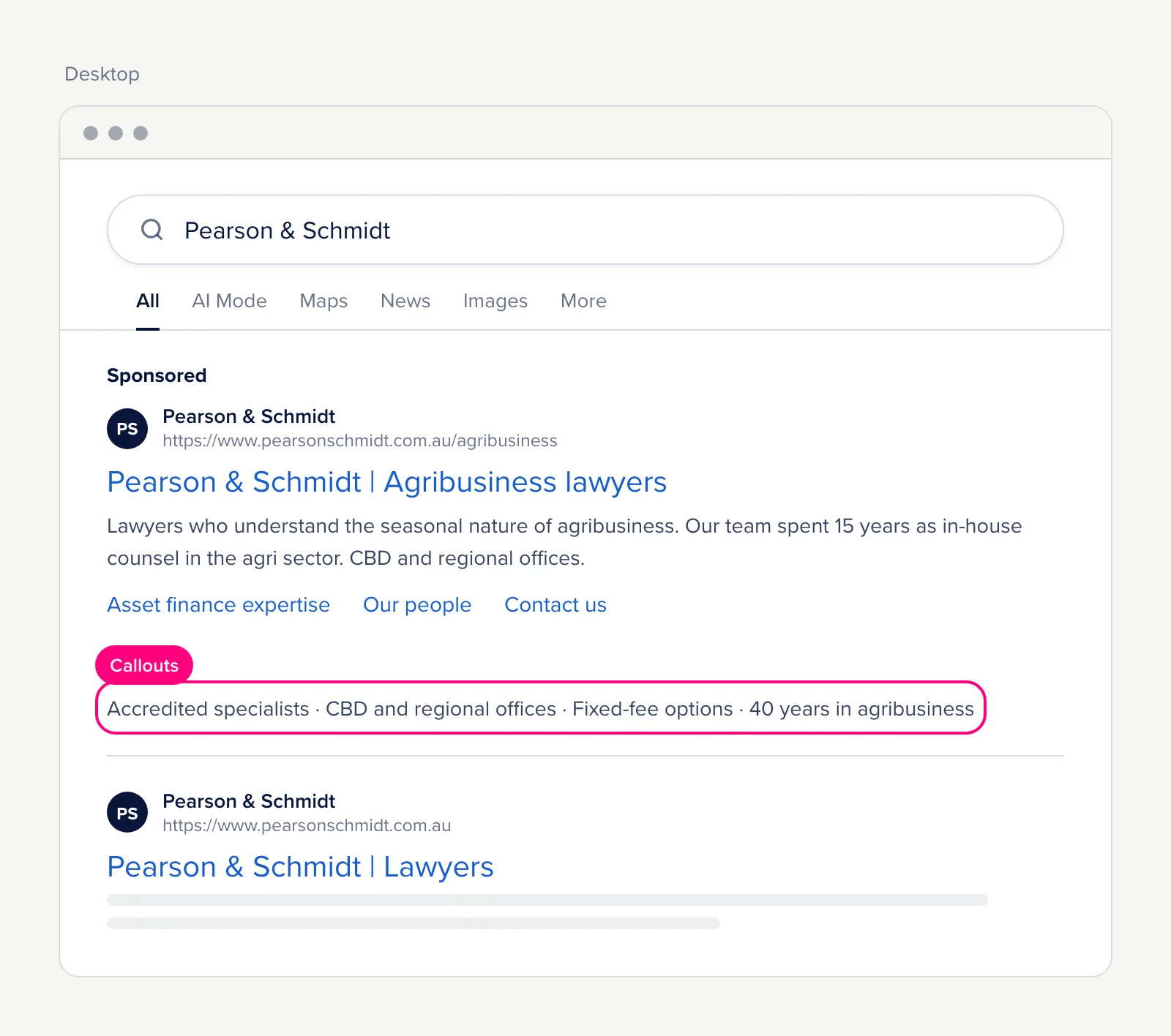
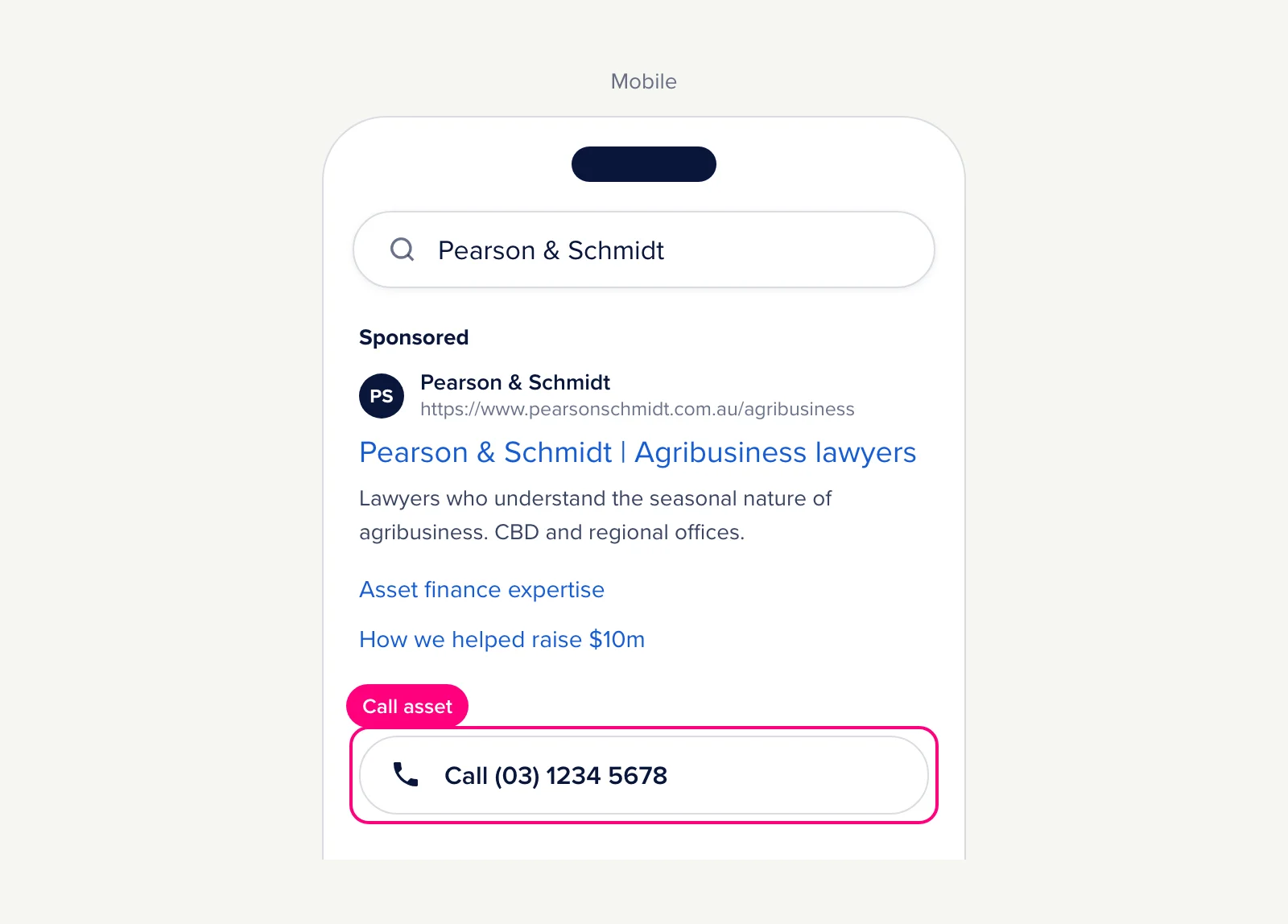
A branded ad puts your firm at the top. Assets (what Google used to call ad extensions) make it bigger. Two of the most useful for law firms:
- Callouts: short, non-clickable phrases under your ad. Firms use them for accreditations, office locations, years of experience or how they charge.
- Call assets: your phone number as a one-tap button. Turn on call reporting so calls count as conversions and you can see which searches led to them.
See what people search alongside your name
Google Analytics hides most of the search terms people use to find your site and Search Console groups and filters what it shows. Your Google Ads search terms report shows far more of what people actually typed with your name:
- your firm name + an area of law
- your firm name + an industry
- your firm name + a lawyer’s or staff member’s name
- your firm name + “reviews”, “fees” or “careers”.
We call these brand-plus searches. They tell you what people already connect with your firm and what they want to know before they call. Use them to decide what your website needs to answer.
Cover your lawyers’ names
Ads on individual lawyers’ names pay off in three situations:
- Common names. If a lawyer shares a name with another lawyer in the same city, an ad group for their name makes sure people find the right one. With a name like Paul Evans, I feel your pain on this one!
- Lateral hires. A new partner’s restraint clause often stops them contacting former clients. When those clients search the partner’s name, a branded ad tells them where the partner has gone.
- Sole practitioners and small firms. Clients often know the lawyer’s name better than the firm’s. Bid on both.
Defend your name when a competitor bids on it
Run your own branded ad. You’ll almost always outrank them on your own name and pay less per click, because your ad is far more relevant to the search.
Bidding on a competitor’s name as a keyword is allowed in Google Ads. Using their trademark in the ad text is different: a trademark owner can complain and Google will restrict trademark use in ads from direct competitors (Google Ads trademark policy). Toro doesn’t bid on competitors’ names for clients and we don’t recommend it.
Branded ads and Google’s AI answers
Branded questions like “is Pearson & Schmidt any good?” often bring up an AI Overview above everything else. Some people skip the results and ask AI Mode directly. That pushes your website further down the page and, as the Pew figures above show, fewer people click through at all.
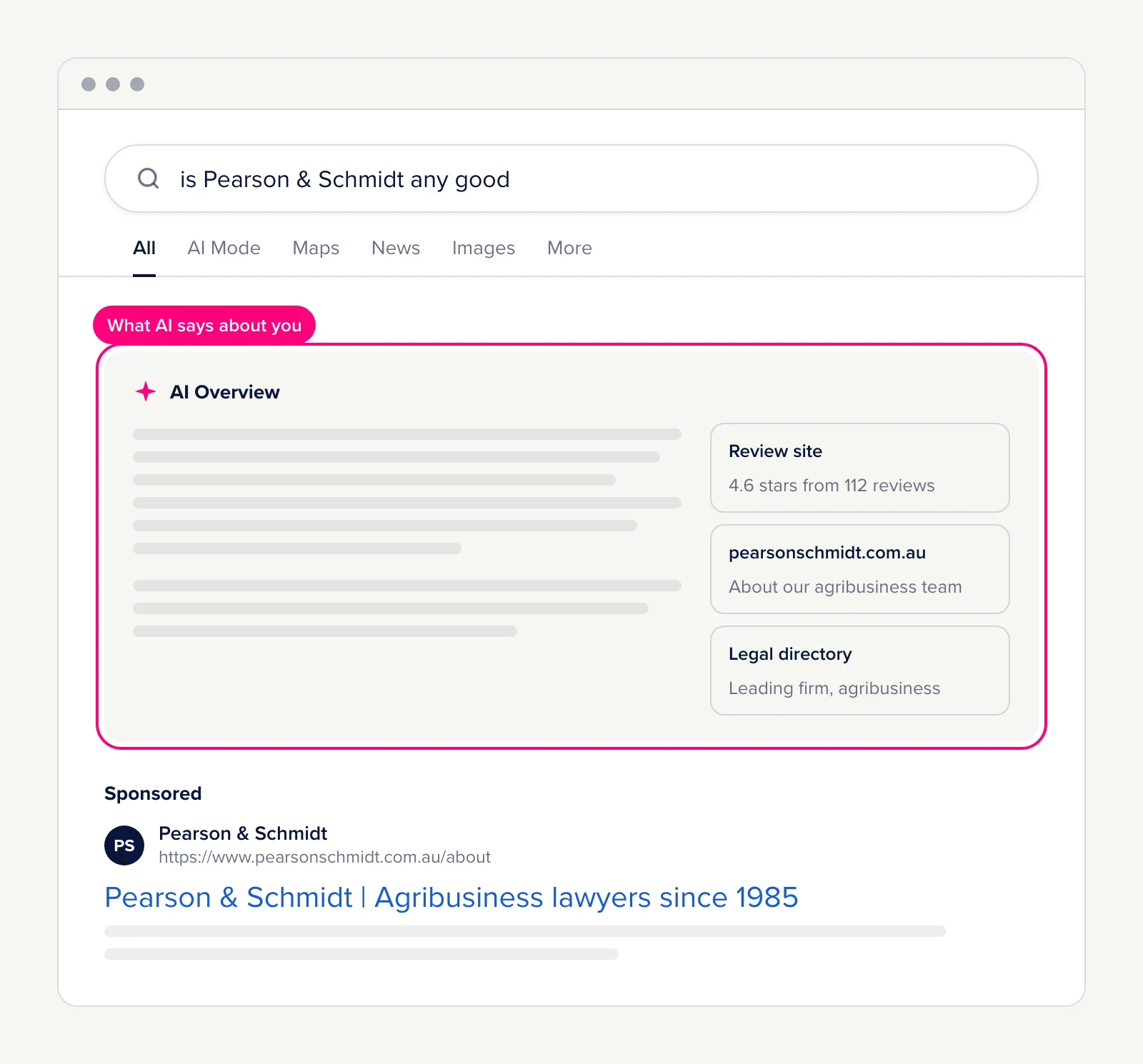
Ads can appear alongside the answer. Search and Performance Max campaigns are automatically eligible to show in AI Overviews and AI Mode with no separate campaign or budget. The ads are labelled “Sponsored” (Google Ads Help). A branded campaign keeps your firm visible on these searches before a competitor bidding on your name takes the spot.
An ad can’t change what the AI says about you, though. That comes from your website, your Google Business Profile, your reviews (and knowing how to remove unfair ones) and your directory listings.
How much does a branded campaign cost?
Usually much less than generic searches like “commercial lawyer Melbourne”. Few advertisers compete for your name and your ad is highly relevant to the search, which earns a high Quality Score and a lower cost per click. We find most firms spend less than $200 a month on branded ads and smaller practices much less.
Google Ads asks for a daily budget, but most firms think monthly. Divide your monthly budget by 30.4, the average number of days in a month. A budget of $1,000 a month is about $32.89 a day. Google may spend more than that on a busy day, but won’t charge more than 30.4 times your daily budget in a month (Google Ads Help).
How to set up a branded campaign in Google Ads
These steps assume some working knowledge of Google Ads.
- Create a separate Search campaign for your brand. Call it “Brand”. Keeping it separate lets you track and budget branded searches on their own.
- Set up an ad group for each set of names. One for the firm, then one for each lawyer you want to cover.
- Use exact and phrase match keywords only. Don’t add your firm name plus “lawyers” as broad match or your ad will show for loosely related searches and spend your budget on the wrong people (keyword matching options).
- Exact match uses square brackets: [your firm name]. Your ad shows for searches with the same meaning, including close variants and misspellings.
- Phrase match uses quotation marks: “your firm name”. Your ad shows for searches that include your firm’s name, such as “your firm name family law”.
- Add common misspellings, abbreviations and former names. For Toro, we’d use [toro legal marketing], [torro legal marketing], [toro digital] (our former name) and “toro legal marketing”.
- Keep branded searches in the brand campaign. If AI Max for Search is on in any campaign, add your firm’s name as a brand inclusion on your brand campaign (Google Ads Help) and as a brand exclusion on your other campaigns (Google Ads Help). Add negative keywords such as “jobs” and “careers” if you don’t want to pay for recruitment searches.
- Write responsive search ads. Each ad takes up to 15 headlines and 4 descriptions. Google tests the combinations. Pin your firm’s name to the first headline so it always shows (Google Ads Help).
- Add your assets. Sitelinks, callouts, a call asset and a location asset linked to your Google Business Profile.
- Set your location and budget. Target the areas your clients come from, then divide your monthly budget by 30.4 for the daily figure.
- Publish and check the search terms report weekly. Add negative keywords for anything irrelevant and note which brand-plus searches your website should answer.
A branded campaign is small on its own. Alongside your website, your Google Business Profile, your reviews and your lawyers’ profiles, it protects the clients your reputation and referrals have already sent your way.
Run the three-search test this week. If anything on those three screens surprises you, start a branded campaign with a modest budget, then fix the sources the AI is quoting.
Frequently asked questions
Do branded Google Ads cannibalise organic clicks?
Some, yes. Some people who click your ad would have clicked your organic result anyway. The ad also keeps competitors out of the top paid spot: a 2021 study of Bing brand searches found competitors took 6% to 15% of a brand’s clicks when the brand’s own ad wasn’t there and 1% to 2% when it was. For most firms, that protection is worth more than the overlap costs.
How much should a law firm spend on branded ads?
Less than you’d think. We find most firms spend less than $200 a month on branded ads and smaller practices much less, because the clicks are cheap. Set a monthly figure, divide it by 30.4 for the daily budget and adjust once you see how many people search your name.
Can competitors bid on my law firm’s name?
Yes. Bidding on a competitor’s name as a keyword is allowed in Google Ads. Using your trademark in their ad text can be restricted if you lodge a trademark complaint with Google. Your own branded ad is the most effective answer either way.
Do branded ads show in Google’s AI Overviews?
They can. Ads can appear in AI Overviews and AI Mode, labelled “Sponsored”. Search and Performance Max campaigns are eligible automatically.
Should I bid on my lawyers’ names as well as the firm’s?
Yes, for lawyers with common names, recent lateral hires and sole practitioners whose clients know the lawyer better than the firm.
Originally published 31 October 2018. Updated November 2026 for AI Overviews, AI Mode and the current Google Ads interface.